n 2026, Canva did something that genuinely reordered the design-tools market: it relaunched Affinity — the professional photo, vector, and layout suite it acquired — as a single unified app, completely free. Not freemium. Not a stripped trial. The full toolset that designers relied on for a decade, bundled into one interface, for zero dollars.
The reaction was immediate. People started canceling Adobe subscriptions, because the math is brutal: Adobe's Photoshop-Illustrator-InDesign trio runs roughly $720 a year, and the credible free alternative now sits one download away. For context, Adobe was busy pushing $60-a-month Creative Cloud while Canva bet that "free forever" would resonate with everyone frustrated by the rent. It did.
If you've ever resented a creative subscription — and who hasn't — this feels like a clean win. Mostly, it is. But "free" is the most expensive word in software, and a studio that takes it at face value isn't thinking clearly. So let's think clearly.
Why this is genuinely good
Credit where it's due, because the upside is real and we don't want to be cynics about it.
The subscription model for creative tools had curdled into something close to a tax. Adobe even got sued over deceptive subscription practices and hidden cancellation fees. For a student, a freelancer, a small studio, or anyone in a market where $720 a year is a serious line item, the arrival of a free, professional-grade, offline-capable suite genuinely lowers the barrier to doing real work. That's not marketing spin — it's a material change in who gets to participate.
And the tool itself is good. Photo, vector, and layout in one app, one universal file type, no per-app upsell. For a great many jobs, the honest answer is that you no longer need to pay anyone anything to do professional design work. That's a real shift, and pretending otherwise to sound sophisticated would be its own kind of dishonesty.
Now the uncomfortable question: who pays?
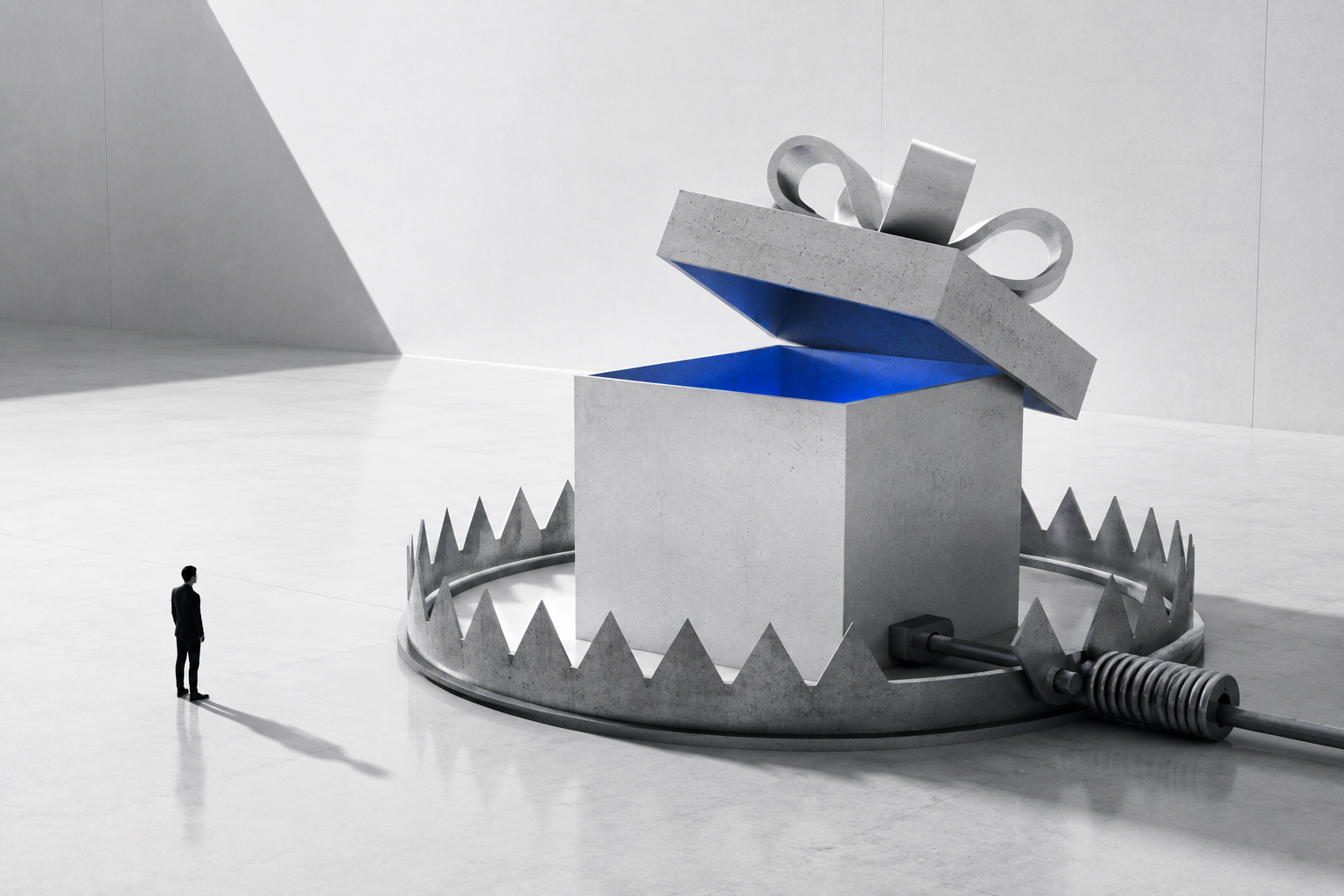
Here's the principle we keep coming back to, and it's worth saying plainly: when a professional tool is free, you are not the customer. You're the strategy.
Canva didn't make Affinity free out of generosity. It made Affinity free because owning the entry point to the design market — where every student, freelancer, and small team starts — is worth far more than the licensing revenue it gave up. Free Affinity is a customer-acquisition engine for the Canva ecosystem, and the AI features, the premium tiers, the upsells live one layer up. The tool is the doorway. The business is the building behind it.
That doesn't make it sinister. It makes it strategic, and strategy has implications you should price in before you build your practice on top of it:
The free thing can stop being free. The community's own quiet fear, stated plainly in the coverage, is that Canva could eventually paywall features. A tool that's free because it serves a parent company's growth goals stays free exactly as long as that calculus holds. When the acquisition has done its job and the growth math changes, the terms can too. You don't control that. They do.
"Free" still has costs that aren't money. An account you must create. A platform you're now inside. Data and telemetry that flow somewhere. AI features that may eventually require the paid tier you were trying to avoid. The price moved from your card statement to your dependency — and dependency is harder to cancel than a subscription.
Consolidation cuts both ways. Canva absorbing Affinity, plus a motion tool, plus stock libraries, plus more, is convenient right up until it isn't. The same consolidation that gives you everything in one place gives one company enormous leverage over the entire stack you depend on. Convenience and lock-in are the same thing viewed from different ends.
The actual lesson isn't "Adobe bad, Canva good"
It would be easy to read this as a morality play — the greedy subscription incumbent versus the generous free disruptor. That framing is comfortable and useless, because next year the roles can swap. Adobe trained its Firefly model specifically on licensed and public-domain content to be "commercially safe" — a genuinely thoughtful move for professionals worried about copyright liability. Canva's free suite is a genuine gift with a genuine strategic motive. Both things are true. Both companies are acting on their economics, not your interests, and assuming otherwise about either one is how you get surprised.
The durable lesson is the one we apply to every tool decision, free or paid:
Separate the work from the platform. Your capability is your skill, your design system, your decisions, and your output — not the app you happen to make them in. Tools that export to open, portable formats keep that capability yours. Tools that trap your work in a proprietary file you can only open in their ecosystem are renting you your own work back. Free or paid, that's the line that matters.
Choose tools for the job, hold the relationship loosely. Use the free suite where it's the best tool — it often is. Use the paid one where it earns its cost. Use the collaborative one where collaboration is the point. The mistake is loyalty: betting your whole practice on one vendor's promises, when the only promise any of them can actually keep is to act in their own interest.
Read the business model, not the price tag. "How much does it cost?" is the wrong first question. "How does this company make money, and what does that make me to them?" is the right one. When the answer is "you're free because you're the funnel," that's fine — as long as you walked in knowing it, and kept a door open.
The bottom line
Free professional design tools are a real win, and the death of the worst excesses of the subscription era is worth celebrating. Use Affinity. It's good, and it's free, and that combination would have been unthinkable a few years ago.
Just don't mistake a strategy for a gift. The tool being free doesn't mean it's costless, permanent, or aligned with you — it means the bill is being paid somewhere you can't see, for reasons that serve someone else's roadmap. Enjoy the tool. Own your work. And keep the door open, because the only leverage a free user has is the ability to leave.
The answer changes when you shift your perspective. From the user's chair, free is a gift. From the boardroom, it's the cheapest customer acquisition in the industry. Both views are correct — and only one of them is planning for next year.