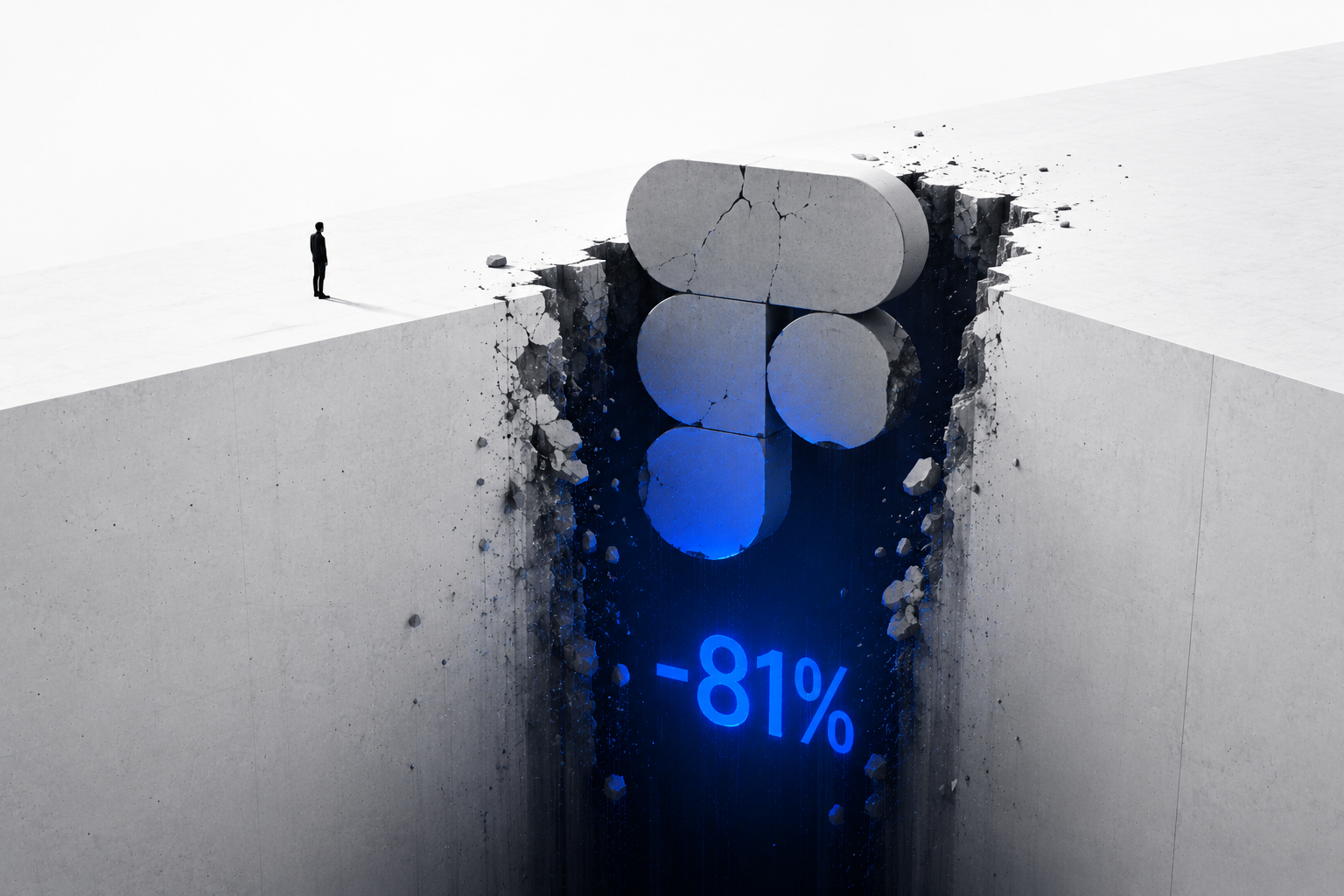
In July 2025, Figma IPO'd in one of the most hyped software debuts in years. The stock priced at $33, opened at $85, and briefly kissed
Here's what makes that interesting, and worth your attention: the product didn't get worse. Figma in 2026 is still the tool most design teams open every morning, still the collaborative canvas that ate Sketch's lunch and forced Adobe to try to buy it for twenty billion dollars. The thing people loved is still there. What collapsed wasn't the software. It was the story about why the software was safe to bet a company on.
That gap — between a great product and a durable position — is the most important thing a design or product team can understand about its own tooling right now. So let's pull it apart.
What actually happened
The short version: Figma got squeezed on the one axis that suddenly matters most, and it doesn't have the balance sheet to win that fight head-on.
In an AI-defined market, capital is capability. Training and serving models is brutally expensive, and the companies with the deepest pockets can simply outspend everyone else on the feature that's reshaping the category. By one analysis, Adobe can outspend Figma on AI development by roughly 17x. Microsoft — which bundles AI design tooling into Microsoft 365 and gives it away to hundreds of millions of seats — can outspend Figma by more than 350x.
That's the whole problem in two numbers. Figma built an extraordinary product and a beloved brand. But "beloved" doesn't show up on the income statement, and in a market where the next decade of features runs on compute you have to pay for, being out-resourced 17-to-1 by one competitor and 350-to-1 by another is an existential math problem, not a marketing one.
Layer on the ordinary gravity of a hot IPO — only about 6% of shares floated to manufacture a pop, lock-ups expiring, insiders selling, the CEO filing to sell millions of shares — and the slide from
The part that should make every team uncomfortable
It would be easy to read this as a stock story and move on. It isn't. It's a tooling story, and it has a direct lesson for anyone whose workflow lives inside a single platform.
A recent survey found that over 60% of Figma users are now at least considering alternatives — not because the tool got bad, but because the context around it got shaky. Adobe's acquisition attempt, the AI-training anxieties (Figma had to pause its "Make Design" feature in 2024 after it was accused of leaning too hard on existing apps and visibly echoing Apple's Weather layout), the pricing increases, the uncertainty about who controls the roadmap. None of that is about whether the rectangle tool works. All of it is about whether you can trust the platform you've built your entire practice on top of.
That's the uncomfortable question: how much of your team's capability is actually yours, and how much is rented from a company whose incentives might diverge from yours next quarter?
When your design system, your component library, your prototypes, your handoff, and your institutional muscle memory all live inside one proprietary tool, you've made a bet. Usually a reasonable one. But you've also handed that vendor enormous leverage over your costs, your data, and your future — and you find out exactly how much leverage only when something shifts: a price hike, an acquisition, a terms-of-service change, a pivot in priorities you didn't vote for.
Why we don't panic about this — and don't ignore it either
We use Figma. We'll probably keep using it. This isn't a "rip out your tools" argument, because tool-switching for its own sake is just churn with extra steps, and the cost of abandoning a platform your whole team is fluent in is real.
But the way we protect ourselves is structural, and it's the same principle we bring to every engagement: own the thing that's hard to replace, rent the thing that's easy to swap.
Own your design decisions, not just your design files. A design system that exists only as a set of Figma components is fragile. A design system that exists as documented principles, named tokens, and a clear rationale — why this spacing scale, why these states, why this motion timing — survives any tool. The file is the expression; the thinking is the asset. Keep the thinking somewhere you control.
Treat tokens and code as the source of truth. The most durable design systems in 2026 don't live in a canvas at all — they live as design tokens and production components that any tool can read from and write to. When your system is codified, the design tool becomes a front-end you can change, not a vault that holds you hostage. This is exactly why we build systems that are tool-agnostic at the foundation and tool-specific only at the surface.
Watch the incentives, not just the features. When you evaluate a platform, the roadmap demo is the least important part. Ask who owns it, how they make money, what happens to your data, and what their position looks like if the market shifts under them. Figma's product was never the risk. Figma's context was. Read the context.
Keep an exit you'll never need. You don't switch tools because you're afraid. You stay free of fear by making sure you always could. Exportable assets, documented systems, portable tokens — these aren't a migration plan, they're leverage. The team that could leave is the team that gets treated well by the vendor that wants them to stay.
The bigger pattern
Figma is the vivid example, but the lesson generalizes to the entire design stack in 2026 — and the stack is consolidating fast. Adobe owns enormous surface area. Canva is absorbing tools and giving them away. Microsoft bundles. The vibe-design tools are venture-funded and burning cash to win share. Every one of these companies is making moves driven by their economics, and your workflow is downstream of decisions you're not in the room for.
That's not a reason to be paranoid. It's a reason to be deliberate. The studios and teams that stay resilient through the next few years of consolidation won't be the ones who picked the "right" tool — nobody can pick the right tool when the ground is moving this fast. They'll be the ones who made sure their actual capability — the systems, the decisions, the craft — lived in something more durable than any one vendor's file format.
The bottom line
Figma losing 81% of its value is not a verdict on Figma. It's a verdict on the difference between a product people love and a position that lasts — and a reminder that those are two completely different things.
Love the tool. Use the tool. Just don't confuse being fluent in a platform with owning your capability. The most expensive mistake in tooling isn't picking the wrong app. It's building something irreplaceable inside something you don't control, and only noticing the difference when the terms change.
Logic over assumption. That applies to your stack too.